
How Long Should Emergency Lights Stay On For?
Are you aware of your emergency lighting commitments?
As a business owner, you’re obligated to ensure that your business is equipped with emergency lighting to ensure a safe and orderly evacuation if the power goes out. Regular testing and maintenance are essential for guaranteeing the highest standards of health and safety.
At Wells Electrical Contractors, our NICEIC-approved contractors are equipped to install, maintain, and test your emergency lighting in line with current UK regulations. With that in mind, how long are your emergency lights required to function?
Do emergency lights stay on all the time?
Emergency lighting must remain illuminated throughout an emergency to keep everyone safe. Yet, according to a 2020 report, as many as 44% of English firmsdon’t have the correct emergency lighting.
Your emergency lights don’t need to stay on all the time. Instead, they’ll remain in standby mode and will trigger whenever necessary. Examples of scenarios where your emergency lights should come on automatically include:
· Local power cuts
· Leak-triggered electrical shutdowns
· Fires
Emergency lights must illuminate long enough to enable evacuation and support the emergency services if they need to get into your building.
Book your Emergency Lighting Test Now
How long should emergency lights stay on in an emergency?
In an emergency, you must have emergency lighting that remains illuminated for at least three hours. Moreover, your emergency lighting must maintain a minimum illumination level throughout the emergency.
Emergencies can cause panic as employees and customers are plunged into darkness. In these scenarios, the risk of tripping, falling, or being crushed by a stampede of people trying to find the exits is enormous.
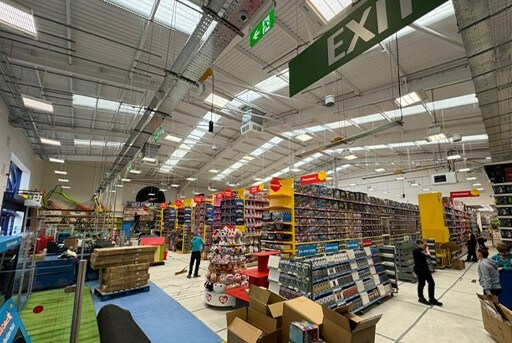
It’s why at Wells Electrical Contractors, we’ve worked with countless businesses up and down the country on their emergency lighting, including Smyths Toys.
How long should emergency lights stay on during a test?
Regular testing is part of running a business with emergency lighting installed. Generally, you must conduct three types of tests: daily, monthly, and annually. Daily and monthly tests are basic visual inspections and functional tests, known as flick tests, but your annual test is a full-duration test.
Full-duration tests check to ensure your emergency lights stay on for a minimum period. Refer to BS-5266 standards for more information on emergency lighting requirements, or get in touch with our team.
To pass the test, your lighting should remain active and provide sufficient illumination for three hours. During this period, a qualified electrician will continually monitor and inspect each emergency light. If there are any issues, our team will identify them and provide the necessary repairs.
Ensuring your emergency lights stay on long enough
Regular testing ensures that your emergency lights are in a perpetual state of readiness. Whilst it might be tempting to put testing on the back burner, the last thing you want is to discover in an emergency that your lights don’t work.
Your full-duration test is the best way to recognise problems and fix them. With the help of a qualified electrician by your side from Wells Electrical Contractors, you can have the peace of mind that you’re in full compliance with UK law.
Note that full-duration tests may be carried out more than once a year in some workplaces. Examples of environments that may require more frequent testing include areas prone to:
· Power outages
· Leaks
· Fires
Unsure if your facility requires more frequent testing? Contact our friendly team for tailored advice on ensuring the highest standards of health and safety in your business.
Emergency lighting legal requirements
BS-5266 provides information on thelegal requirements of emergency lighting. Generally, businesses must focus on duration and illumination level.
Emergency escape lighting must remain switched on for a duration of three hours. The regulations state this applies to places that cannot be evacuated immediately, such as hotels. Minimum illumination requirements are one hour in locations where:
1. The premises may be evacuated immediately.
2. The premises don’t need to be reoccupied quickly.
Tests must be carried out annually, and if the emergency lighting cannot stay illuminated for the necessary period, the backup battery must be replaced.
Minimum illumination levels must also be maintained throughout the test. Emergency lighting guidelines specify different illumination levels based on the location of the light.
For example, floor-level emergency lights require at least one lux. In contrast, anti-panic areas require at least 0.5 lux. In context, one lux is the equivalent of a large domestic candle power, so most emergency lighting fixtures aren’t especially bright.
Professional emergency light testing
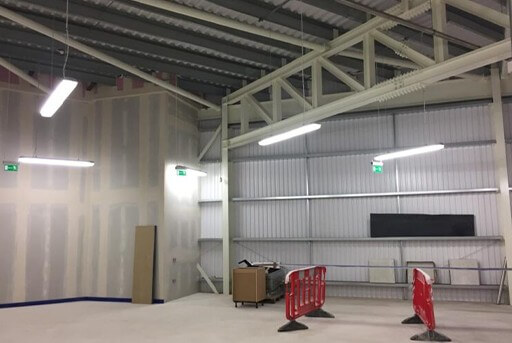
Emergency lighting testing is critical to ensure you remain in compliance with health and safety regulations. Refer to BS-EN-50172 and BS-5266-8 for minimum testing provisions. How often you need to test may vary based on the site you operate.
Daily and monthly tests may be conducted by a designated “responsible person” who will also oversee the testing schedule. However, the full-duration test must be conducted by a professional.
At Wells Electrical Contractors, we work with our clients to make emergency lighting testing simple. We fit the full-duration test around your schedule to minimise disruption to your business while providing a test you can rely on.
When should a duration test on emergency lighting be carried out?
Full-duration tests must be conducted at least once every year. When you carry this test out, it usually depends on when your emergency lighting was installed. No regulations mandate a specific time of year or day/night to carry out these tests.
Each option has its pros and cons. For example, testing during the day is easier but may make checking the lights more difficult because of factors like strong sunshine. On the other hand, testing at night minimises business disruption but can be more of a headache to organise.
We understand that testing can disrupt your business, which is why we’re available 24/7 to test at a time to suit you. To learn more about organising your custom testing schedule for your emergency lights, contact Wells Electrical for a consultation.